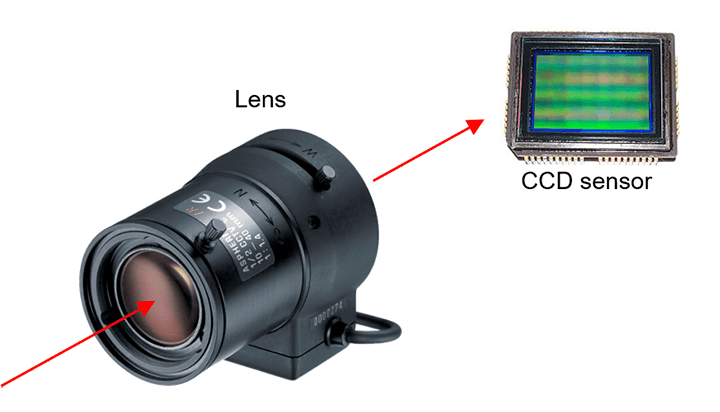
In this article, I talk about the difference between CCD and CMOS sensors for CCTV and what are the advantages and disadvantages of these technologies.

When a camera captures an image, the sensor is the element that converts the received light into electrical or digital signals.
After this conversion to signals, the camera’s main processor can work and enhance the image before sending it for recording or live viewing on a monitor.
These sensors are found in all types of cameras, from cell phones, tablets, and CCTV security cameras.
The image sensor on a CCTV camera
Just behind the lens of your camera, if you remove the lens of a box CCTV camera, you will see the sensor and notice its size.
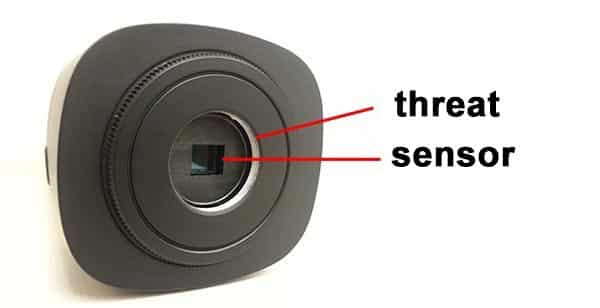
There has always been a debate about what technology is best, CCD or CMOS, and there are some pros and cons for the two technologies.
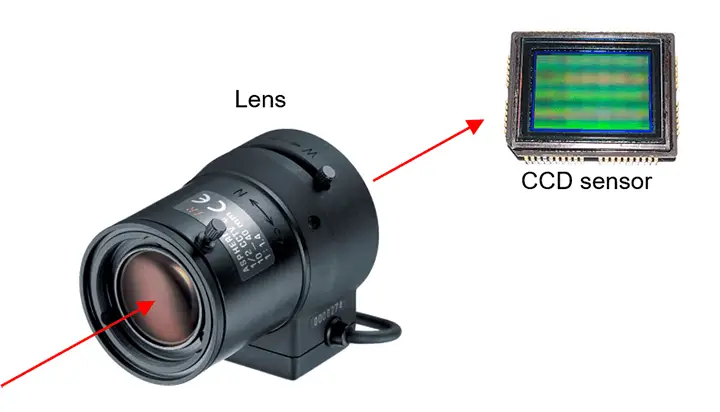
A long time ago in a traditional CCTV camera store, the seller was very proud to say that the camera he was offering had a CCD and that guarantees better image quality compared to cheaper cameras with CMOS sensors.
But was the seller using the right argument to make his sale? Was the CCD even better than CMOS?
Which sensor is better for CCTV cameras?
That depends on what you want from your CCTV camera.
It also depends on the type of camera you are using, analog or IP.
CCD sensors are primarily used on analog cameras, especially the cheap models that don’t have great quality. So be careful with that.
Of course, there are also good-quality cameras that use CCD, so there are some situations where the CCD is better and others that it’s not.
CMOS is mainly used for IP cameras but there are also modern analog cameras that use such technology.
So, at the end of the day, there’s no right or wrong choice, it all depends on the type of camera you are using and the overall quality of the other components.
Here’s a table comparing the CMOS and CCD sensors
Differences between CCD and CMOS
Here’s a table comparing the CMOS and CCD sensors.
|
CMOS |
CCD |
|---|---|
|
Less power consumption |
Consumes more energy |
|
Better correction of light exposure |
No light exposure correction |
|
Less sensitivity to light |
Greater sensitivity to light |
|
Fast signals conversion |
Slow signals conversion |
|
Used in modern cameras |
Used in old cameras |
CCD and CMOS sensors size
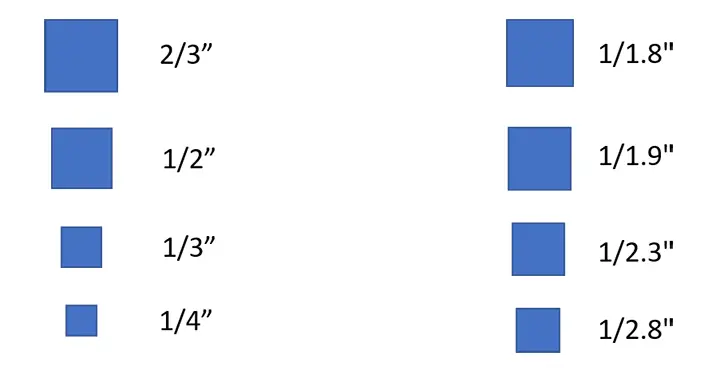
There are different sizes for CCD and CMOS sensors.
Big sensors are better to receive more light and convert them into signals.
Usually, the cameras with big sensors are much better in low light conditions.
Example of CCD and CMOS on cameras
As I said before, different types of cameras use different types of sensors. The picture below shows examples of analog and IP cameras that either uses CCD or CMOS sensors.
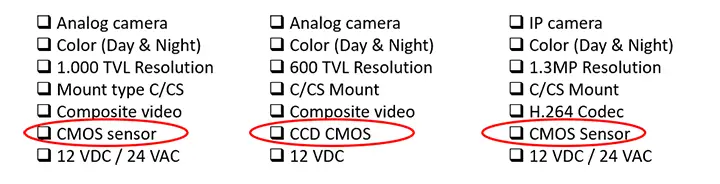
There’s no right or wrong about CCD and CMPS sensors, there are pros and cons on both technologies.
If you are looking for a camera that works on low light condition a big CCD sensor can help you out, so take a look at the specs before buying.
If you want to use high-resolution modern IP cameras, the CMOS is the way to go, but you don’t need to worry too much about that because practically every IP camera comes with a CMOS sensor these days.
You also need to be careful with excessive marketing that pushes sales by saying the camera has a “Sony sensor“. Most of the cameras do have these sensors because most camera manufacturers buys them from Sony.
please contact my email address i couldn’t solve the problem
I wonder if I can give you my e-mail address.
These are all utterly hideous.
very informative and revealing bravo!
every post is very informative for your health ..
every post is very informative for your health ..
I wonder if I can give you my e-mail address.
Over the past few years, cross-border communication has increased dramatically. Individuals from diverse linguistic backgrounds are connecting more frequently for business, travel, education, and social purposes. However, language barriers remain a major obstacle.
Classic translation tools including smartphone applications and pocket translators often require manual input. Because of this, many users are turning to smart translation earbuds as a more efficient solution.
AI translation earbuds integrate AI technology with real-time speech processing to deliver instant language translation. With hands-free operation, people can speak freely while the system translates spoken language in real time.
One major strength of this technology lies in their ease of use. In contrast to traditional translators, these earbuds allow users to maintain eye contact, improving overall interaction quality. This feature is especially valuable during face-to-face conversations, negotiations, or casual chats.
An additional advantage of intelligent earbud translators is their support for multiple languages. Advanced systems offer translation across numerous languages, making them suitable across borders and cultures. Some systems are trained on diverse language datasets, reducing misunderstanding.
Precision also plays a crucial role. Modern AI translation earbuds use continuously improving AI models to better capture the meaning of conversations. In contrast to basic translators, these solutions improve over time, resulting in better performance.
These smart devices are also widely used in professional environments. Global conferences often involve participants who speak different languages. With AI translation earbuds, collaboration improves significantly. Such innovation enhances clarity and productivity.
International travelers increasingly rely on AI translation earbuds. In restaurants, shops, and public places, misunderstandings are common. Using hands-free translation devices, travelers can navigate foreign environments with confidence. Ultimately, this provides improved confidence while traveling.
Another emerging use case for smart translation devices is language learning. Students can compare spoken languages instantly, enhancing language comprehension. Over time, users may develop better pronunciation.
User comfort and privacy play a significant role. Today’s translation earbuds are lightweight and ergonomic. Some systems offer noise reduction and clear audio output, ensuring accurate translation delivery. In many cases, users can hear translations without external speakers, making them suitable for professional use.
As technology continues to evolve, AI translation earbuds are likely to gain wider adoption. Future developments are expected to enhance usability and performance. Such progress will help connect people worldwide.
In conclusion, smart translation earbuds offer a practical solution in overcoming language barriers. Through hands-free multilingual support, these devices enable smoother and more natural conversations. With increasing global demand, AI translation earbuds are set to play a vital role across international environments.
https://controlc.com/4b751d70